
Embeddings vs Attention: Two Different Ways AI Finds Meaning
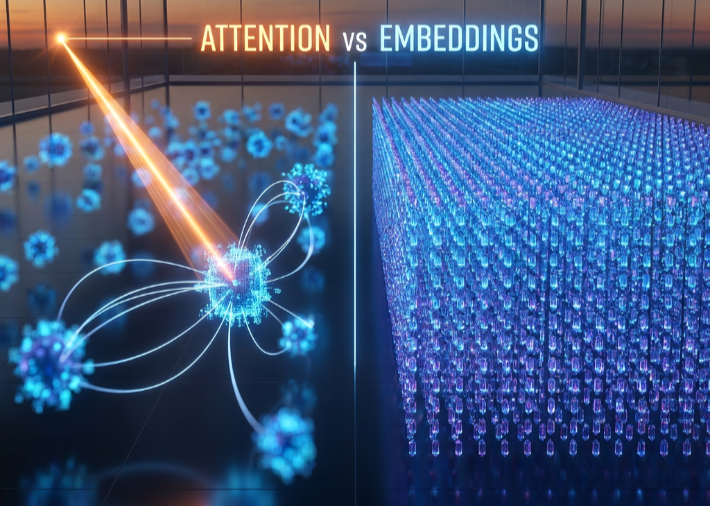
Understanding why modern AI needs both, and why confusing them leads to poor AI system design
If you've spent any time reading about artificial intelligence recently, you've almost certainly come across terms like embeddings, Transformers, attention, vector databases, and Retrieval-Augmented Generation (RAG).
Unfortunately, these concepts are often introduced independently, making it difficult to understand how they fit together.
One misconception appears repeatedly:
“Aren't embeddings and attention basically doing the same thing?”
The answer is no.
Although both help AI work with language, they solve fundamentally different problems.
Embeddings help AI understand what information means.
Attention helps AI decide which information matters most right now.
That distinction is one of the keys to understanding how modern AI systems are built.
Two Different Questions
Imagine you're preparing a presentation on inflation.
Before you begin writing, you visit a large library.
Your first challenge isn't deciding which pages to read.
It's finding the right books.
Once you've selected a handful of relevant books, your next challenge is deciding which chapters, paragraphs, and sentences deserve your attention.
Modern AI faces exactly the same problem.
First, it needs to locate relevant information.
Then it needs to determine which parts of that information are most important for answering the question.
Embeddings solve the first problem.
Attention solves the second.
Although they often work together, they perform very different roles.
Embeddings: Creating a Map of Meaning
Imagine every book in that library has an invisible set of coordinates.
Books about economics sit near other economics books.
Books about machine learning sit close to statistics and computer science.
Books about medicine are grouped near biology and chemistry.
Without reading every page, you could quickly locate books on similar topics simply by looking at where they appear on the map.
That is essentially what an embedding does.
An embedding converts text into a numerical representation known as a vector, that captures its semantic meaning.
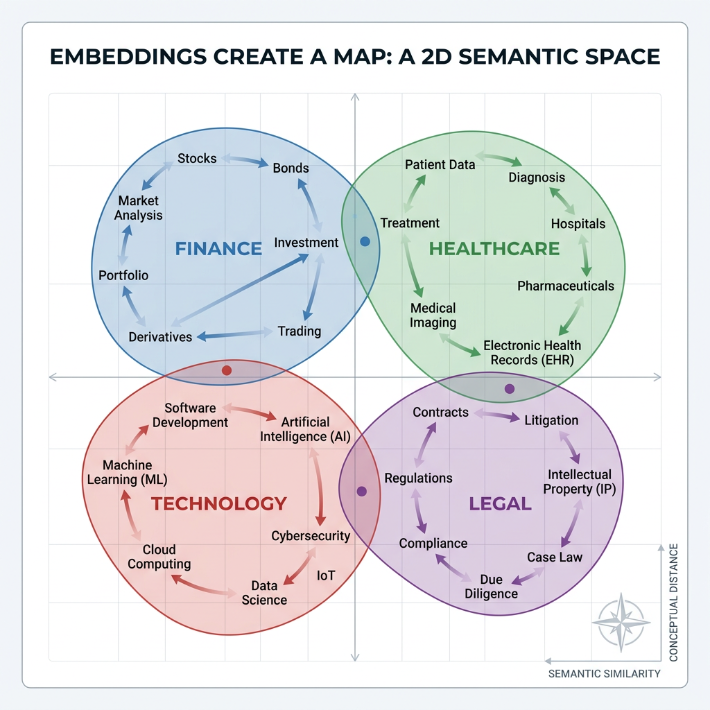
The remarkable property of embeddings is that information with similar meaning tends to occupy nearby positions in this mathematical space.
For example, the embeddings for:
doctor
physician
medical practitioner
will appear much closer together than:
doctor
automobile
This allows AI systems to search by meaning rather than exact wording.
A customer searching for "automobile insurance" can still retrieve documents containing "car insurance."
The words differ.
The meaning is similar.
Embeddings capture that similarity.
Attention: Deciding What Matters
Now suppose you've found five excellent books on inflation.
You don't read every page equally.
As you begin writing your report, you focus on the chapters discussing monetary policy, interest rates, and consumer prices.
You skim over sections covering historical biographies or unrelated economic events.
Your focus changes depending on the question you're trying to answer.
That is attention.
Unlike embeddings, attention is dynamic.
It does not permanently represent meaning.
Instead, it continually evaluates which pieces of information deserve the greatest focus at a particular moment.
When a language model processes a sentence, it determines which previous words are most relevant for understanding the next word.
That process happens repeatedly throughout the generation of a response.
Attention allows language models to connect ideas separated by many sentences, or even many pages.
Static Meaning vs Dynamic Relevance
One useful way to think about the distinction is this:
Embeddings create a map.
Attention plans the route.
The map doesn't change every time you ask a new question.
But the route certainly does.
Similarly, embeddings provide a relatively stable representation of meaning.
Attention changes continuously depending on the current context.
A question about climate change and a question about renewable energy may retrieve many of the same documents.
However, the model will pay attention to different sections of those documents depending on the question being asked.
Why Retrieval-Augmented Generation Uses Embeddings
One of the biggest challenges facing enterprise AI is scale.
Imagine an organization with:
two million emails
fifty thousand technical documents
thousands of policies
years of customer support conversations
No language model can realistically process all of that information every time someone asks a question.
Instead, the system first performs a semantic search.
Embeddings allow the AI to identify which documents are most relevant to the user's question.
Rather than reading everything, it retrieves only the information that is likely to be useful.
This dramatically improves both efficiency and accuracy.
Why Large Language Models Use Attention
Once those documents have been retrieved, another challenge begins.
The model now needs to understand them.
Which paragraph contains the answer?
Which sentence defines the policy?
Which earlier statement explains a later reference?
Which pronoun refers to which person?
This is where attention takes over.
Attention helps the model determine which pieces of information deserve the greatest focus while generating its response.
In other words:
Embeddings retrieve knowledge.
Attention reasons over knowledge.
Modern AI systems need both.
Putting It All Together
A typical enterprise AI system might follow this sequence:
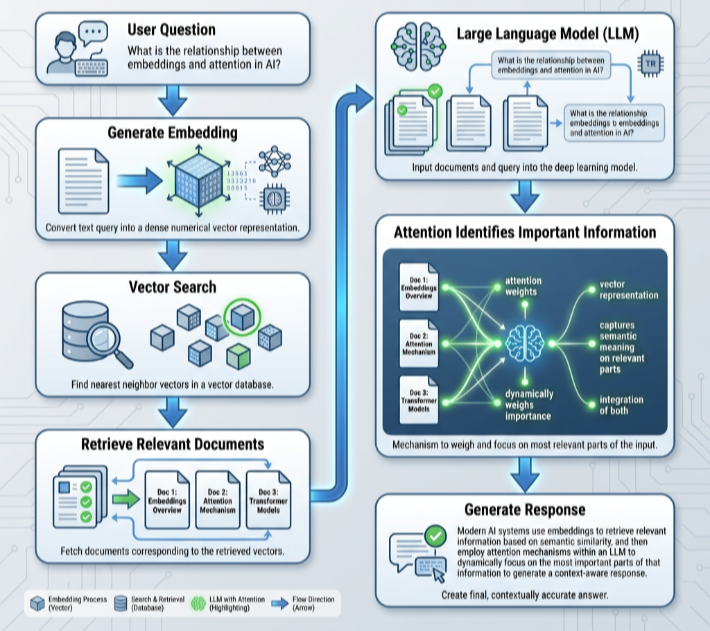
Notice that embeddings and attention perform different jobs.
Embeddings help the system find information.
Attention helps the model understand and use it.
Confusing these two concepts often leads to poor architectural decisions.
A Consultant's Perspective
Suppose a client tells you:
“Our chatbot doesn't give very good answers.“
At first glance, that sounds like a language model problem.
Often, it isn't.
The real issue could lie elsewhere.
Perhaps the embedding model isn't accurately capturing the meaning of documents.
Perhaps the documents have been divided into sections that are too large or too small.
Perhaps the retrieval system is returning irrelevant information.
Or perhaps the correct information is being retrieved, but the prompt doesn't encourage the language model to focus on the right parts of the context.
Each of these problems requires a different solution.
Understanding the difference between embeddings and attention allows consultants and architects to diagnose the real issue instead of simply replacing the language model.
Common Misconceptions
Several misconceptions appear repeatedly in discussions about modern AI.
“Embeddings understand context.“
Not really.
Embeddings capture semantic similarity, but they don't dynamically interpret context in the way attention mechanisms do.
“Attention searches databases.“
No.
Attention only works on the information that has already been provided to the model.
Finding relevant documents is the job of embeddings and retrieval systems.
“A bigger language model eliminates the need for embeddings.“
Not at all.
Even the largest language models cannot efficiently search millions of enterprise documents without retrieval.
“Vector databases replace language models.“
Again, no.
Vector databases retrieve information.
Language models interpret it.
They complement each other rather than compete.
Beyond Large Language Models
Although embeddings and attention have become closely associated with generative AI, both have much broader applications.
Embeddings are widely used in:
recommendation systems
semantic search
clustering
fraud detection
anomaly detection
Attention mechanisms now appear in:
computer vision
speech recognition
multimodal AI
robotics
protein folding
The underlying principles remain remarkably consistent.
Represent meaning efficiently.
Then focus on what matters most.
Lessons for Consultants and Data Scientists
One of the biggest lessons from modern AI architecture is that there is rarely a single component responsible for success.
A well-designed system requires multiple capabilities working together.
Before deciding that a language model needs to be replaced, ask yourself:
Is the system retrieving the right information?
Are the embeddings accurately representing meaning?
Is the retrieved context relevant?
Is too much irrelevant information competing for attention?
Does the prompt guide the model toward the most important information?
These questions often have a greater impact on performance than simply choosing a newer or larger language model.
Final Thoughts
Embeddings and attention are sometimes presented as competing ideas.
They aren't.
They solve different problems.
Embeddings help AI understand where knowledge lives.
Attention helps AI determine what knowledge matters.
One finds the information.
The other makes sense of it.
Modern AI systems rely on both.
Understanding the distinction doesn't just make you better at explaining AI.
It makes you better at designing AI systems that solve real business problems.
Further Reading
Mikolov, T., Chen, K., Corrado, G., & Dean, J. (2013): Efficient Estimation of Word Representations in Vector Space.
Introduced Word2Vec, demonstrating how semantic relationships could be learned from large text corpora.
Vaswani, A., et al. (2017): Attention Is All You Need.
The landmark paper that introduced the Transformer architecture and self-attention.
Devlin, J., Chang, M.-W., Lee, K., & Toutanova, K. (2018): BERT: Pre-training of Deep Bidirectional Transformers for Language Understanding.
Showed how Transformer-based language models could learn rich contextual representations that transformed NLP.
Lewis, P., et al. (2020): Retrieval-Augmented Generation for Knowledge-Intensive NLP Tasks.
Introduced the RAG architecture, combining embeddings, retrieval, and language models into a unified system.
