
From Transformers to Agentic AI: How Modern AI Systems Are Built
How the evolution from language models to AI agents is changing the way organizations automate knowledge work
The release of Attention Is All You Need in 2017 marked one of the most important turning points in artificial intelligence.
The Transformer architecture introduced in that paper changed how machines process information. It enabled the development of large language models (LLMs) that could understand and generate human-like text at an unprecedented scale.
However, while large language models are impressive, they are only one component of modern AI systems.
A language model can write an email, summarize a document, explain a concept, or generate computer code. But most business processes require more than generating text.
They require retrieving information, using tools, making decisions, interacting with systems, and completing tasks.
A financial analyst does not simply need a summary of quarterly performance. They need an analysis of trends, identification of anomalies, comparison against forecasts, and recommendations for action.
A customer service representative does not simply need a response to a customer question. They need customer history retrieved, policies checked, eligibility verified, and potentially a resolution executed.
This represents the next evolution of AI.
From systems that generate content, to systems that accomplish goals.
This is the shift toward agentic AI.
The Foundation: Transformers Changed How AI Processes Information
Before Transformers, many AI systems processed language sequentially.
Models such as Recurrent Neural Networks (RNNs) and Long Short-Term Memory networks (LSTMs) processed text one element at a time, making it difficult to maintain relationships across long sequences.
The Transformer architecture introduced a different approach.
Through the concept of attention, models could identify relationships between different parts of an input sequence, regardless of their position.
This allowed AI systems to:
process much larger amounts of information
capture more complex relationships
train more efficiently
scale to billions of parameters
The result was a new class of models called foundation models.
These models became the foundation for modern AI applications across language, vision, speech, and multimodal systems.
However, a critical distinction is often misunderstood:
A large language model is not an intelligent assistant by itself.
It is a powerful component.
What Does a Large Language Model Actually Do?
At its core, a large language model predicts the most likely next token based on the context it receives.
That sounds simple, but at scale it produces remarkably sophisticated capabilities.
The model can:
answer questions
summarize information
translate languages
write code
analyze text
generate content
However, an LLM does not inherently:
know your company's internal information
access your databases
browse your systems
understand your business processes
execute actions on your behalf
A useful analogy is that an LLM is like a highly knowledgeable consultant sitting in a room—but without access to your files, systems, or tools.
To become useful in an enterprise environment, it needs additional capabilities.
Building an AI System: The Components Around the Model
Modern AI applications combine multiple components.
A typical architecture includes the following:
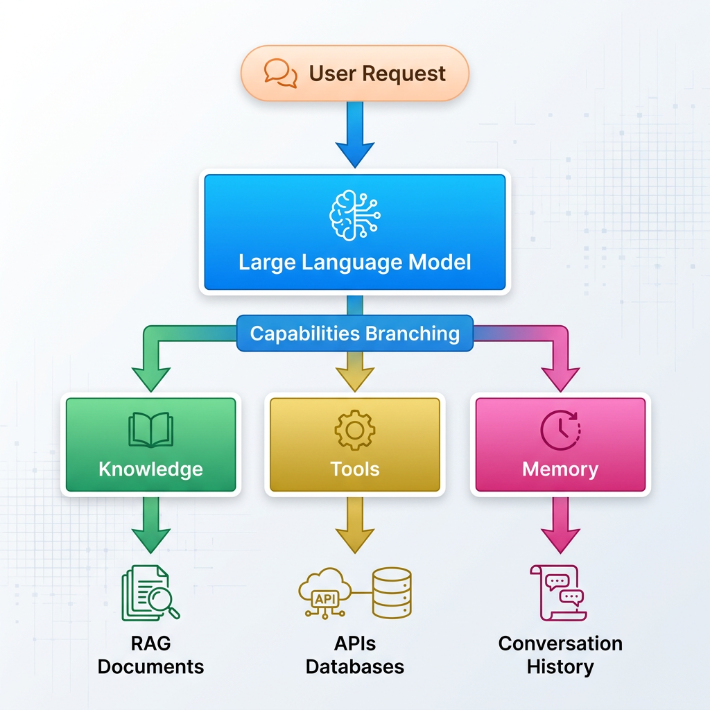
The LLM provides reasoning and language capabilities.
The surrounding components provide access, context, and the ability to take action.
This distinction is essential for consultants designing AI solutions.
The question is no longer:
"Which model should we use?"
The better question is:
"What system architecture will allow AI to solve this business problem reliably?"
Retrieval-Augmented Generation: Giving AI Access to Knowledge
One of the first limitations organizations encounter with LLMs is that the model does not know their private information.
A company may have:
internal policies
product documentation
customer records
technical manuals
legal documents
operational procedures
This information was not part of the model's original training.
Retrieval-Augmented Generation (RAG) addresses this challenge.
Instead of expecting the model to memorize everything, the system retrieves relevant information at the time it is needed.
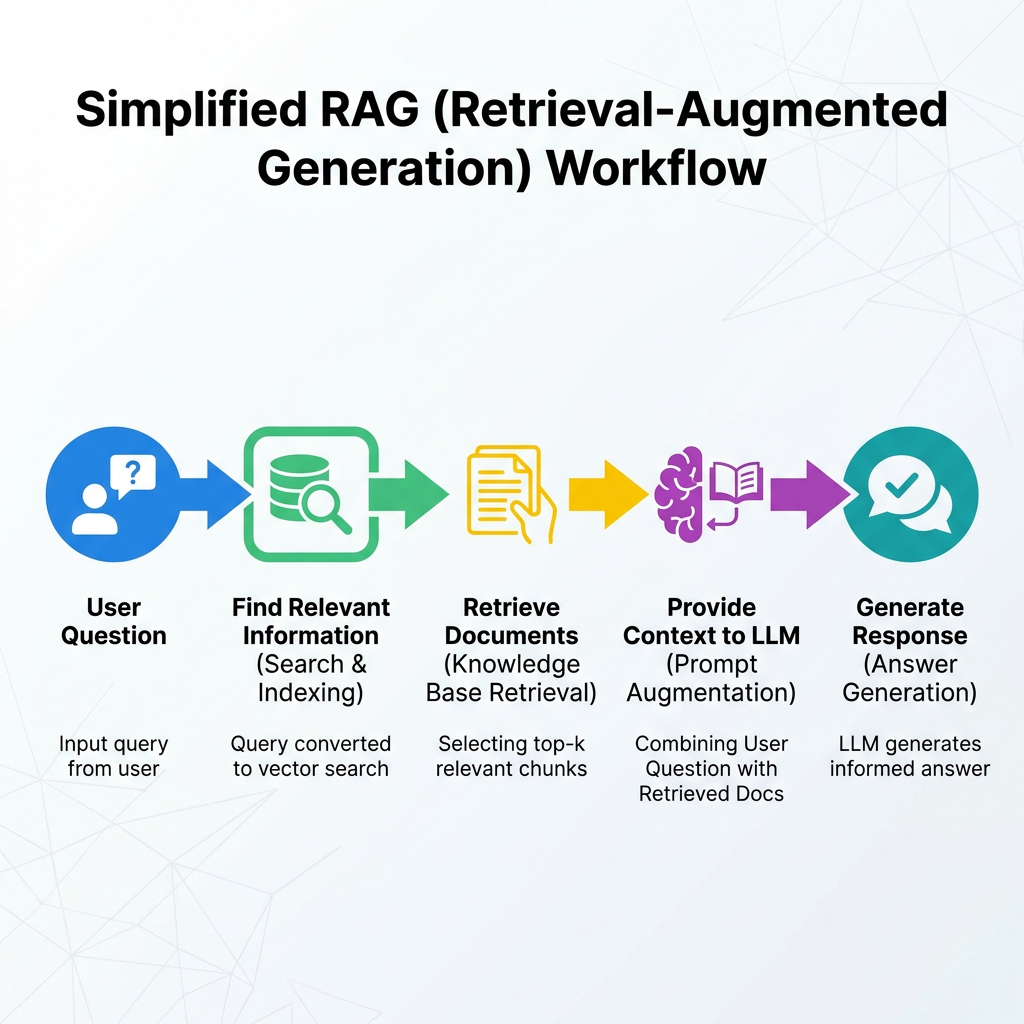
From a consulting perspective, RAG highlights an important lesson:
The biggest challenge in enterprise AI is often not the model.
It is the data.
Successful AI solutions depend on:
high-quality information
effective search and retrieval
appropriate permissions
document organization
governance processes
Tools: Moving from Answers to Actions
RAG gives AI access to information.
Tools give AI the ability to interact with systems.
Consider the difference.
A chatbot might answer:
"This customer appears eligible for a refund."
An AI agent could:
Retrieve customer information
Check refund policies
Calculate eligibility
Create the refund request
Update the CRM system
Notify the customer
Tools allow AI systems to move beyond generating responses.
Examples include:
databases
APIs
enterprise applications
search engines
code execution environments
workflow systems
This is one of the most important shifts in modern AI.
The model is no longer just producing text.
It is participating in a business process.
What Makes an AI Agent Different?
A traditional chatbot follows a simple pattern:
Question → Answer
An AI agent follows a different pattern:
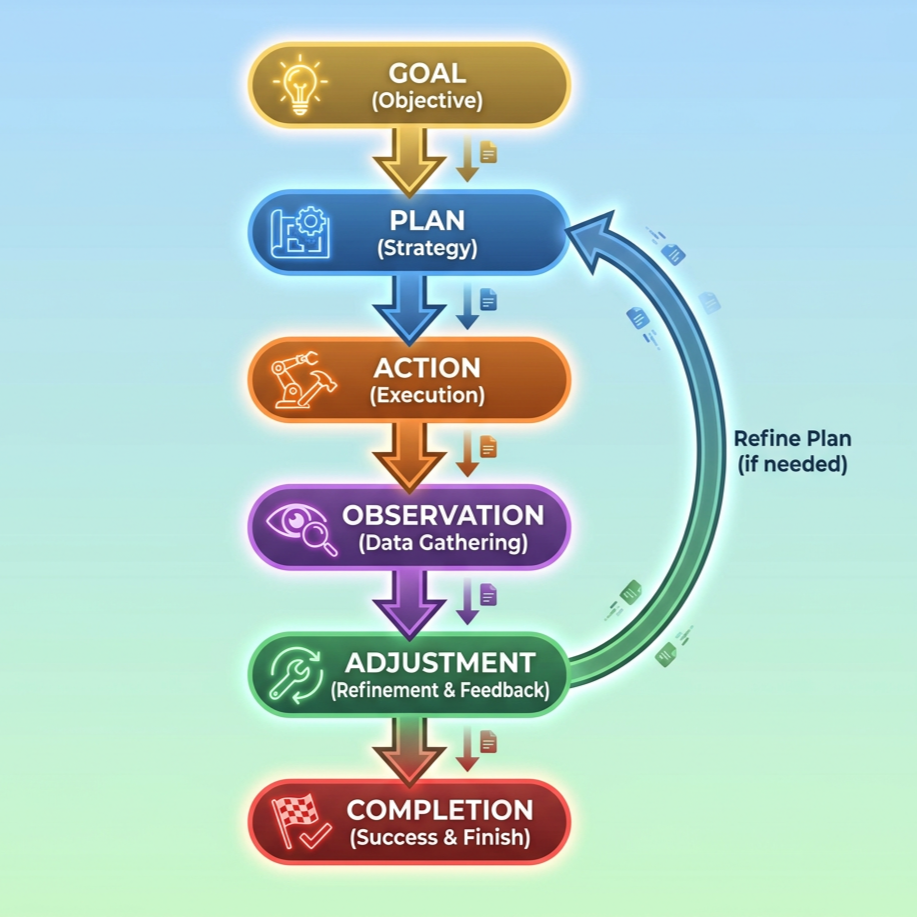
Agents are designed to accomplish objectives.
For example:
A user might ask:
"Prepare a competitive analysis of our three largest competitors."
An agent could:
Search for relevant information
Collect data from approved sources
Analyze differences
Create a structured report
Review its findings
Present recommendations
The important difference is that the AI system manages a workflow rather than simply generating a response.
Memory: Giving AI Systems Continuity
Another important capability in agentic systems is memory.
There are several types of memory:
Short-term memory
Information available during the current interaction.
Example:
The context of a conversation.
Long-term memory
Information retained across interactions.
Example:
A customer's previous preferences or history.
Working memory
Temporary information used while completing a task.
Example:
Intermediate results during an analysis.
Memory introduces powerful capabilities, but also new challenges.
Organizations must consider:
privacy
security
data ownership
accuracy
outdated information
A system that remembers incorrectly can be worse than one that does not remember at all.
Planning and Reasoning
Many business tasks require multiple steps.
An executive may ask:
"Why did sales decline last quarter, and what actions should we take?"
Answering this requires:
Accessing sales data
Comparing historical performance
Identifying trends
Investigating possible causes
Generating recommendations
Agentic systems attempt to break complex goals into smaller tasks and execute them systematically.
This capability moves AI closer to becoming a digital collaborator rather than simply a content generator.
Multi-Agent Systems
An emerging approach is to use multiple specialized agents rather than one general-purpose agent.
For example:
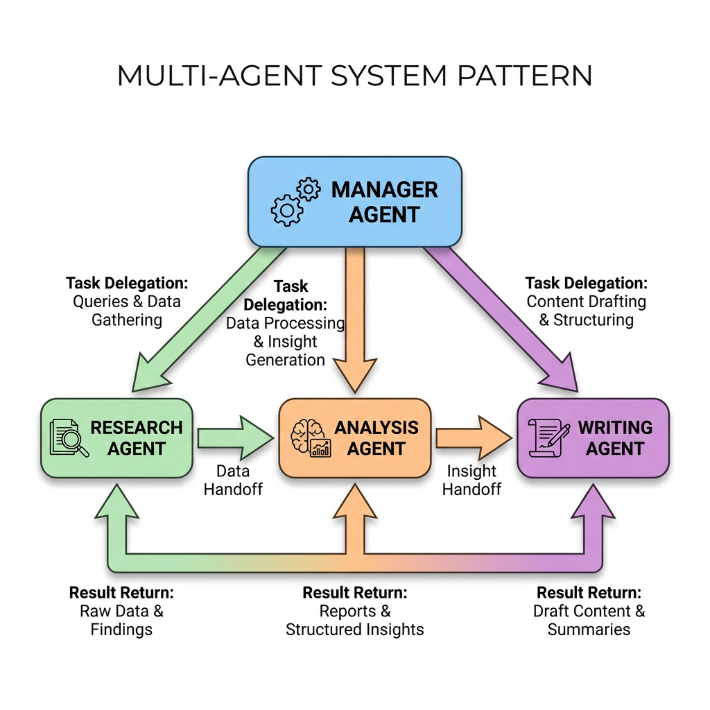
A business research assistant might include:
a research agent that gathers information
an analysis agent that interprets data
a writing agent that prepares reports
a review agent that checks quality
The advantage is specialization.
However, multi-agent systems also introduce challenges:
increased complexity
higher costs
coordination problems
evaluation difficulties
More agents do not automatically mean better results.
Good architecture still matters.
The Consultant's Role: Designing AI Systems, Not Choosing Models
The rise of agentic AI changes the role of consultants.
The question is no longer:
"Which large language model should we use?"
The more important questions are:
What business process are we improving?
What information does the AI system require?
Which actions should it be allowed to take?
Where is human approval required?
How will performance be measured?
How will risks be managed?
The best AI solutions are not built by simply connecting an LLM to a chatbot interface.
They are designed around business workflows.
Where Agentic AI Will Create Value
The potential applications are broad.
Customer Service
Moving from:
"Answer customer questions."
to:
"Resolve customer issues."
Software Development
Moving from:
"Generate code."
to:
"Plan, implement, test, and improve software."
Consulting
Moving from:
"Create reports."
to:
"Research, analyze, draft, and refine recommendations."
Operations
Moving from:
"Monitor systems."
to:
"Detect problems and initiate responses."
The Reality Check: AI Agents Are Not Magic
Despite the excitement, agentic AI is not a replacement for careful engineering.
Important challenges remain:
hallucinations
unreliable reasoning
security vulnerabilities
excessive autonomy
unclear accountability
difficulty evaluating performance
The future is unlikely to be fully autonomous AI replacing human judgement.
A more realistic vision is AI systems that handle increasingly complex tasks while humans provide oversight, expertise, and strategic direction.
From Models to Systems
The biggest change in AI is not simply that models have become larger.
It is that we are moving from standalone models to complete intelligent systems.
Transformers gave AI the ability to process and generate information.
RAG gave AI access to organizational knowledge.
Tools gave AI the ability to interact with systems.
Agents combine these capabilities to pursue goals and complete tasks.
For consultants, the opportunity is not just understanding the latest model.
It is understanding how these components fit together to create reliable, valuable business solutions.
The future of AI will not be defined by the model alone.
It will be defined by how intelligently we build the systems around it.
Further Reading
Vaswani, A., et al. (2017): Attention Is All You Need.
The foundational paper introducing the Transformer architecture.
Lewis, P., et al. (2020): Retrieval-Augmented Generation for Knowledge-Intensive NLP Tasks.
The paper introducing RAG as a method for combining language models with external knowledge sources.
Yao, S., et al. (2023): ReAct: Synergizing Reasoning and Acting in Language Models.
A key paper describing how language models can combine reasoning with tool-based actions.
Wei, J., et al. (2022): Chain-of-Thought Prompting Elicits Reasoning in Large Language Models.
A landmark paper exploring how prompting techniques can improve multi-step reasoning.
Final Thoughts
The journey from Transformers to agentic AI represents a fundamental shift in how we think about artificial intelligence.
The first generation of AI systems focused on prediction.
The next generation focused on generation.
The emerging generation focuses on action.
For organizations, the opportunity is not simply to adopt a more powerful model.
It is to redesign how work gets done.
The organizations that succeed with AI will not necessarily be those with access to the largest models.
They will be those that understand how to combine models, data, tools, and human expertise into intelligent systems that create measurable business value.
