
Predicting Customer Billing Intents for Intelligent IVR Routing
Goal
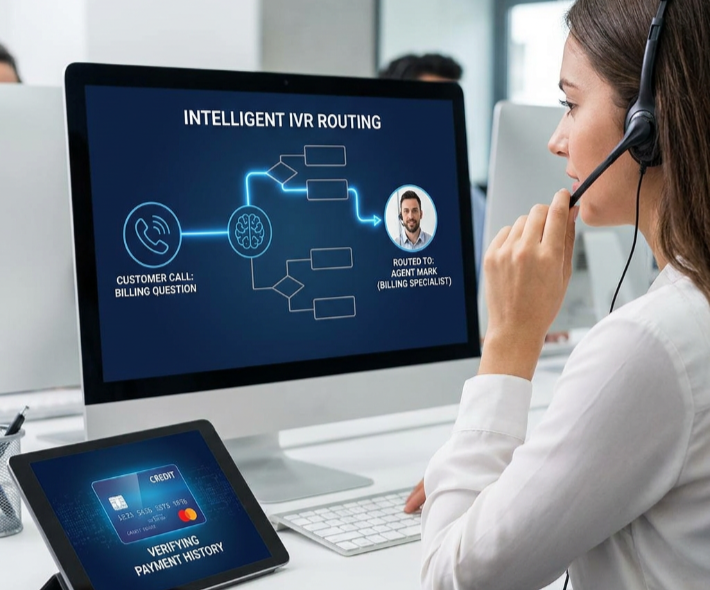
To develop a machine learning solution capable of predicting a customer's billing intent before they reached an agent, enabling the IVR system to present the most likely options and automate routine enquiries.
Preamble
Telecommunications providers receive millions of customer service calls each year, with billing enquiries representing one of the largest contact center workloads. Many of these calls relate to routine issues such as invoice enquiries, payment problems or unexpected charges that can potentially be resolved without agent involvement.
The objective of this project was to predict a customer's billing intent before they spoke with a customer service representative. By combining information extracted from historical customer conversations with transactional and customer profile data, the solution estimated the most likely reason for the call.
These predictions were used to personalize the IVR menu, allowing customers to select the option most relevant to their enquiry. The goal was to increase self-service adoption, reduce costly agent interactions and improve the customer experience.
Data
The project combined multiple sources of customer information.
Historical telephone conversations between customers and contact center agents provided the conversational data used to identify billing intents. This was supplemented with structured operational data, including customer profiles, billing history, payment activity, account status, product subscriptions and previous customer interactions.
Combining conversational and structured data enabled the model to consider both the customer's language and the context surrounding their account, resulting in more accurate intent predictions.
Method
A multi-modal machine learning approach combined Natural Language Processing with structured predictive modelling.
Customer and agent conversations were classified and converted into machine learning features using LLM analytic techniques. Additional features were engineered from customer and transactional data, including billing activity, payment behavior and account characteristics.
Several supervised machine learning algorithms were evaluated using cross-validation and hyperparameter optimization. Rather than producing a single prediction, the final model generated a ranked list of the most probable billing intents, allowing the IVR system to present customers with the options they were most likely calling about.
Results
The model successfully combined conversational and structured customer data to improve billing intent prediction over text-only or transaction-data-only approaches.
Instead of presenting every caller with the same IVR menu, the system was provided the personalized menu options based on the customer's account history and conversation. This approach had the potential to reduce routine calls reaching customer service representatives, lowering operating costs while improving response times and customer satisfaction.
The project also provided valuable insights into customer behavior and common billing issues, supporting ongoing improvements to IVR design and contact center operations.
Business Impact
Personalized IVR menu generation
Increased self-service adoption
Reduced contact center operating costs
Faster customer issue resolution
Improved customer experience
Better utilization of conversational and customer data
Actionable insights into billing-related customer behavior
This project demonstrates how LLM outputs can feed into traditional machine learning models to combine conversational AI with operational customer data and build intelligent self-service systems that reduce costs while delivering a faster and more personalized customer experience.