
Customer Engagement Flow Analysis and Opportunity Sizing

Goal
Develop a data-driven framework to classify corporate and commercial banking customers into strategic engagement segments, track how they transitioned over a twelve-month period, and identify customer segments with the greatest opportunity for future revenue growth.
Preamble
Understanding how customers progress through different stages of engagement is essential for developing effective retention and growth strategies. Rather than viewing customers as a static population, this project examined how they moved between engagement segments over time, providing valuable insight into the customer lifecycle.
Customers were initially classified into one of six engagement segments:
Business and Retail Customers
High Potentials
Business-only Customers
Transactors
Disengaged
Attrited Customers
Separate models were developed for new and existing corporate and commercial customers, recognizing that these groups often exhibit different behavioral patterns and growth opportunities.
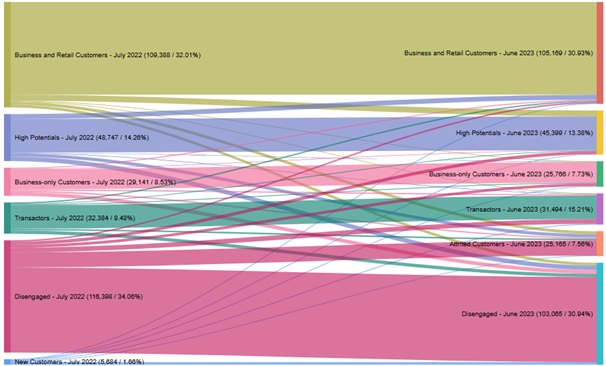
The resulting customer transitions were visualized using Sankey diagrams, allowing stakeholders to clearly see the movement of customers between segments over a twelve-month period. These engagement flows were then used as the foundation for an Opportunity Sizing analysis to estimate the revenue uplift available through targeted customer interventions.
Data
The project used a comprehensive customer dataset containing corporate and commercial banking customers together with their engagement segment at two points in time, separated by one year.
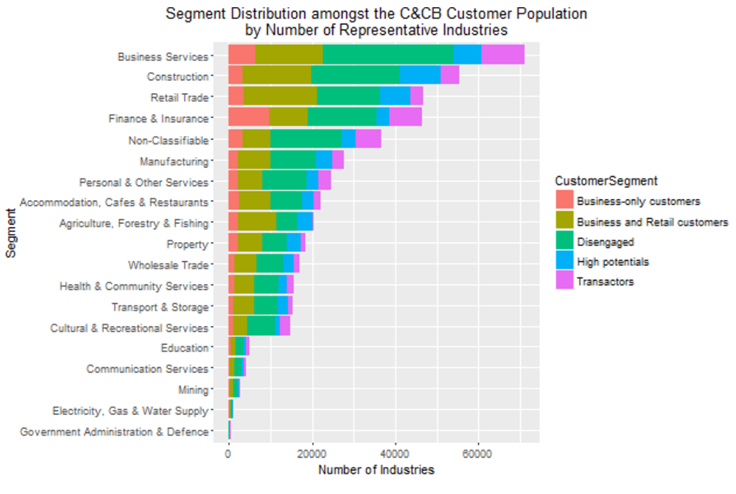
In addition to the engagement classifications, the data included customer profile information, industry classifications, estimated turnover, trading history and financial performance measures such as Risk Adjusted Income (RAI). These attributes were used to identify the characteristics of the bank's highest-value customers and to estimate the opportunity associated with customers moving into more valuable segments.
Method
Customers were first classified into their engagement segment at the beginning of the analysis period and then matched to their segment one year later. This produced a complete picture of customer movement across the engagement lifecycle.
The transition data was visualized using Sankey diagrams, enabling business stakeholders to quickly identify where customers were progressing, remaining stable or becoming disengaged.
A separate Opportunity Sizing model was then developed to identify customers with the greatest potential to transition into the bank's highest-value Business and Retail Customer segment. The model examined customer characteristics including industry, estimated turnover and trading history to identify customers most closely matching the profile of existing high-value customers. Potential financial uplift was estimated using Risk Adjusted Income (RAI), allowing opportunities to be prioritized according to expected business value.
Results
The project provided the bank with a clear visual representation of how customers moved between engagement segments over time, highlighting both positive customer progression and areas where customer disengagement or attrition was occurring.
By combining engagement flow analysis with Opportunity Sizing, the bank was able to identify customer segments offering the greatest potential for future growth. The modelling identified thousands of customers, representing around 15% of the eligible customer base, that exhibited characteristics similar to the bank's highest-value Business and Retail Customers. The estimated annual revenue uplift associated with successfully developing these customers exceeded multiple millions of dollars, with additional upside expected from customers excluded due to incomplete data.
The resulting analysis provided a practical framework for prioritizing customer engagement strategies, allocating relationship management resources and focusing marketing initiatives on the customers most likely to deliver long-term value.
Business Impact
Customer lifecycle analysis through engagement flow tracking
Visualization of customer movement using Sankey diagrams
Identification of high-potential customer segments
Quantification of revenue uplift opportunities
Improved targeting of customer engagement initiatives
Better allocation of relationship management resources
Data-driven prioritisation of commercial growth strategies
This project demonstrates how customer analytics can move beyond traditional reporting by combining behavioral segmentation, visual analytics and predictive modelling to identify where customer value is created, lost and most effectively developed.